I mentioned briefly in my last post that I'm a participant in Coverdell World Wise Schools. Through this program, I'm matched with a classroom in the States and we can correspond as we wish, sharing pictures and stories. Hopefully, this results in students at home learning about a new culture along with their volunteers.
When I got a packet of letters from students in my World Wise Schools match, I was really impressed to see how much thought they had put into the questions they asked me and what they wanted to know about the Philippines and Philippine culture. Their questions were more intelligent and thoughtful than some of the questions I field from adults more than twice their age and experience.
I spent the afternoon answering the questions which recurred most often throughout the letters I received, and some questions I thought were really important. I couldn't answer them all, but I got to almost 20 of them and it occurred to me that some of the questions and answers deserved to be posted here. So, here are some questions from middle school students in New Jersey, and my humble answers to them. Warning: this is gonna be a long one, folks.
How can ordinary teenagers make a difference in the world?
Making a difference starts in your own community. The world is big and there are problems at your doorstep as well as half a world away. I wish I had done more volunteering closer to home, since I believe that volunteering in a soup kitchen or homeless shelter makes a greater direct, immediate impact on those in need at home than Peace Corps does abroad. There are many volunteer opportunities available if you just look: Habitat for Humanity, SPCA, 4H, various other community volunteer organizations designed for young people like the YES program, and, when you’re no longer teenagers, Americorps or Teach for America. You can also do adopt-a-highway programs, arrange a litter clean up, or try to start composting and organic farming or gardening. If there are causes you care about like fundraising for diabetes, cancer, HIV/AIDS or autism, there are opportunities for that as well. With time, energy and care, you can contribute to the wellbeing of your community in far greater ways than you can probably imagine.
Are you a better person for joining the Peace Corps?
Absolutely not! I am trying to become a more patient person, a more compassionate person, more understanding and more empathetic. Living in a different culture provides me opportunities to become better in those ways, but I have to work on it myself. However, I think the root of this question does not lie in what we are trying to develop within ourselves, but in buying into the essential nobility of joining the Peace Corps, which is a grave fallacy. We who join Peace Corps do have altruistic reasons for joining, but our reasons are not all selfless either. Of course there will be the people who say “I just want to help people!” Frankly, they're lying. As you can see from my answer about making a difference, you don’t have to go far to help people. Some volunteers want professional experience, some want to travel no matter where, some want high adventure, some want a totally different experience than most of their peers. My foremost reason for joining the Peace Corps was to be involved in something positive for the world, to put good karma into the ether in any way that I could help. I wanted to do HIV/AIDS education work, which I haven’t had a chance to do yet, and I wanted to provide individual attention to students who may struggle in English class. But I also wanted the teaching experience, I wanted to learn about a new culture, I wanted to experience completely new things, I wanted to travel, and I’m not ashamed of that. No Peace Corps Volunteer is any better a person than the volunteers and community organizers who devote their time to making the world a better place from home.
Did you want to be placed in the Philippines?
The Peace Corps has an extremely long, tedious and difficult application process which is too boring to explain. To put it simply: you don’t get to request where you will go. You may put in geographical preferences, like Eastern Europe or Latin America, and you can put where you don’t want to go, but because of your skills set, which determines what job sector you’re qualified for, and your medical needs, which determines which countries you can or cannot be sent to, you are never guaranteed anything as far as your geographical preference. They may even put you exactly where you didn’t want to go, but this shouldn’t be a deterrent. My father served in the Peace Corps during the Vietnam war, and he wanted to go to French-speaking Africa, and he didn’t want to go anywhere near the war. Well, they sent him to Thailand, right next to Vietnam, and he had the time of his life.
Personally, I wanted to go to Thailand because it’s part of my heritage and I speak Thai. Turns out, this is exactly why I was barred from ever going to Thailand with the Peace Corps. They want their volunteers to experience a totally new culture. Once I knew this, I put as my preference, like my father before me, Francophone West Africa. The Peace Corps was recruiting for French speakers, they were excited about my desire to serve in Africa, which is where the fewest people want to go, and I was nominated for a program in Francophone West Africa. However, during my long medical screening process, I found out that I’m unable to eat gluten (a protein found in wheat, barley and rye), and I could not go to West Africa as a result. Peace Corps decided to send me to Southeast Asia, reminding me that it wouldn’t be Thailand, and in the end I was extremely happy to come to the Philippines.
What do you miss about America?
Of course I miss my friends and family. 27 months is a long time to be apart from them. I’m missing out on weddings, funerals, births, many crucial moments in the lives of my loved ones because I made the decision to be here. I knew that at the outset, of course, but faced with the reality of missing these moments, these people, it’s much harder to shrug off the time factor.
The other big thing I miss is food. Since I’m gluten intolerant, it’s not always easy for me to eat here, though of course not as difficult as it would be in other parts of the world. Filipinos have been very much influenced by 400 years of Spanish rule and 50 years of US occupation. That means that they use many Western ingredients that I can’t have, and because of the threat of contamination, it’s even harder for me. If something I am able to eat, like a fried fish, is touching a breaded piece of pork, or was fried in oil that previously fried something battered by flour, then I can’t eat it. I have been able to remain healthy here, but only through vigilance and discipline and culinary abstinence. So I miss the food I can get easily at home: gluten-free breads, cereals and desserts; peanut butter; Thai food; sushi; candy, chips and junk food.
Do you speak a foreign language? Do you speak Filipino?
Any foreign language? I grew up speaking both English and Thai in my house, and I spent about five years studying French in middle and high school.
There are hundreds of languages and dialects in the Philippines. English and Filipino, which is actually Tagalog, are listed as official languages. When my group of volunteers, Philippines batch 267, got here, we were split into three geographical and linguistic groups which would determine where our permanent sites would ultimately be. My group was sent to Dumaguete on Negros Oriental, part of the Visayas (Vi-SY-ahs). For three months, we spent intensive classtime learning Cebuano, or Visaya, or Bisaya. Cebuano has 20 million native speakers throughout the Visayan islands and greater Philippines, whereas Tagalog has 11 million.
Because the Philippines has such a high rate of moderate English proficiency, it is possible to get by without learning a Filipino language very well. Some volunteers never speak it at all. As a teacher, I am obligated to speak English all day at work, so learning is especially difficult for English Education volunteers because they aren’t as immersed in the language as volunteers in other sectors in the Philippines, coastal resource management (CRM) and children, youth and families (CYF).
What do you do in your spare time?
I read a lot of books. I have been here for almost eight months now, and I am currently reading my 23rd book since arriving in country. This is more than I’ve read for pleasure since I was in middle school myself. It’s very satisfying to have the time to read what you want, for whatever reason you want. I also use the internet a lot, and I try to spend time writing. Some weekends, I visit other volunteers relatively close to me.
Do the Philippines have seasons?
The Philippines have basically two seasons: ting-uwan (rainy season) and ting-init (hot season). It is both rainy and hot during both seasons, but the intensity of the rain during ting-uwan is shocking, as is the intensity of the heat during ting-init.
Over the course of the year, there are other mga ting (seasons), like ting-ani (harvest season), ting-prutas (fruit season), ting-bagyo (typhoon season), ting-mangga (mango season), and so on and so forth. Anyting goes. We have a joke among the Peace Corps volunteers: we’ll add the word ting before anything. It’s always ting-uncomfortable, we’ll say of the weather. It’s ting-ako na (season of me, now).
What kinds of sports and music are popular in the Philippines?
Basketball is a big, big past time here. If there isn’t a decent basketball court in every neighborhood, there’s at least a makeshift one. There are informal games all the time, and plenty of people from the neighborhood or community will come to watch. My host brother would turn the TV to a sports channel and watch basketball, past games and present, all day, and then watch shows about basketball players. Philippines national obsession. With the emergence of Manny Pacquiao, Filipino boxing legend and recent defeater of Oscar De La Hoya, boxing has gained popularity.
Filipinos love all kinds of music, without irony. Celine Dion, Queen, Mariah Carey, the Star Wars theme, Christmas music no matter the ting, the Carpenters, stadium evangelical gospel, anything. Videoke (karaoke with moving pictures of anything you can think of on the screen) is another national obsession, and you can hear it all the time. My students particularly enjoy current American hip-hop, and it can be heard at all times, and they frequently prepare dance numbers to it.
What is Filipino food like? Do you like it?
Filipinos eat white rice at every meal, even breakfast. For some volunteers, this is a big adjustment and sometimes one which they will never get used to or come to enjoy. Personally, because I am used to eating rice regularly and because I can’t eat common items like bread or flour, I really prefer to eat rice anyway, so it’s not a problem for me. Filipino main dishes are usually fried or boiled, they often contain a lot of fish and pork, and their main seasonings are salt and soy sauce. Because soy sauce contains gluten, sometimes my host families had trouble finding things to make for me. However, with a little imagination, they were able to remove the soy sauce or substitute it with something safe for me. I like many Filipino foods, but because of my dietary restrictions I am often limited in what I can have and how it can be flavored, resulting in the same kinds of bland dishes over and over. Now that I live on my own, I can make my own food, and generally I wouldn’t describe it as Filipino. I am, however, very much into eating and making Filipino desserts.
Showing posts with label gluten-free. Show all posts
Showing posts with label gluten-free. Show all posts
Wednesday, March 25, 2009

Sunday, March 22, 2009
23
This weekend, Connie arranged a birthday party for me at her house in Inopacan. She prepared an unbelievable epic of a meal, worthy of the Philippines, including a killer buko salad and a make-your-own halo halo buffet. Sean and Cassie came up from the depths of Southern Leyte, and Syd was there, whom I haven’t seen since we were both in Manila for different reasons in January. She brought Matt, a volunteer from batch 266 who also lives on Leyte. It was amazing to reconnect with everyone together. In classic Pinoy fashion, we ate our meal and snacks and desserts over a six hour period and went home clutching our bellies, satisfied.

Connie cooking up some bean sprouts

Me, Sean, Connie, Cassie, Connie's feast and a kind of inverted tapestry of the Last Supper

Me and some key halo halo ingredients before this gorgeous group of PCVs sang Happy Birthday to me. Who needs cake when you have halo halo?

Syd, Sean, Matt and Cassie building their ultimate halo halos

Syd digging mightily on her halo halo
On my actual birthday, it was like the universe had decided to take it easy on me. At school, which is finished for the summer at this point, I only collected tests, and the Ruby students were joking with me and making me laugh. I got an order of one of my favorite Pinoy snacks, puto cheese, which is like a cupcake except made of rice flour so I can actually eat it. It’s not always there, so when I saw the little stacked mountain of them at the bakeshop I inwardly rejoiced. I got three packages I’d been waiting for, and a series of letters from my World Wise Schools students in New Jersey, which were very pleasing to receive and read. I'm preparing a response to almost 20 common questions the students have about service and the Philippines. I’ve been introspective about service lately, and I’ve also been having to write about it in various forms, and having to do that makes me articulate my challenges and successes and helps me to navigate them. That evening after work, I ate as many puto cheeses as I wanted, had pad Thai for dinner, and waited to feel 23. I’m still waiting.


On my actual birthday, it was like the universe had decided to take it easy on me. At school, which is finished for the summer at this point, I only collected tests, and the Ruby students were joking with me and making me laugh. I got an order of one of my favorite Pinoy snacks, puto cheese, which is like a cupcake except made of rice flour so I can actually eat it. It’s not always there, so when I saw the little stacked mountain of them at the bakeshop I inwardly rejoiced. I got three packages I’d been waiting for, and a series of letters from my World Wise Schools students in New Jersey, which were very pleasing to receive and read. I'm preparing a response to almost 20 common questions the students have about service and the Philippines. I’ve been introspective about service lately, and I’ve also been having to write about it in various forms, and having to do that makes me articulate my challenges and successes and helps me to navigate them. That evening after work, I ate as many puto cheeses as I wanted, had pad Thai for dinner, and waited to feel 23. I’m still waiting.
Wednesday, February 25, 2009
Adventures in Pinoy Cuisine III
The Philippines is a country that takes eating very seriously. This means taking snack, or merienda, between each meal. Often snack is something sweet and full of gluten, sometimes it’s just fruit, and other times it’s a full on meal. Champorado is a popular snack item here, and unlike some recurring snacks, I never got sick of it. When I first had champorado made by my host family’s house helper in Dumaguete, I fell in love.
Champorado is basically chocolate rice pudding. How could anyone resist? However, I soon learned that not all champorado are created equal, and despite the ease of preparation and varied recipe options, it is easy to mess up champorado. For example, burning the chocolate is never advised and will result in an entirely ruined batch. I also prefer a thick champorado, not a runny one, and too little sugar or too much tablea, cocoa tablets, can also ruin your champorado. Some of my batchmates were also familiar with it as a breakfast food, but were not thrilled about it, even saying that it didn't taste like chocolate. I concluded that they had not had good champorado.
In Dumaguete I’d seen tablea for sale all over, but since coming to live in Hilongos, I hadn’t seen any. Today I resolved to find some and buy it so I could try my hand at my own champorado. I bought oversized tablea because I asked the tindera, the saleswoman, which made the best champorado and she indicated a set of them made in Hindang, the next town north.
I chose this recipe because it’s simple, straightforward and looked easy and delicious. This is another recipe that I think looks as clear, possibly easier for those in the states. The following is the recipe I chose and my modifications.
4-5 pieces of tablea (blocks of pure cocoa the circumference of nickels – I think bakers’ chocolate or plain unsweetened cocoa as in the alternate recipe could substitute) melted in ½ cup of water
1 cup of rice (many recipes call for sweet rice but I don’t know which kind is sweet and I have 5 kilos of rice right here, why buy more?)
2 ½ cups of water
½ cup of brown sugar
¼ can of evaporated milk
As I mentioned, I bought oversized tablea, about double the size of regular ones. I broke up two and melted these with the ½ cup of water in my makeshift double boiler because I’ve burned chocolate in the past and have no low heat with this stove. When I make this in the future, I might use a fraction less tablea, maybe 1 ½ or 1 ¾.
Cook the rice with the 2 ½ cups of water in a saucepan, stirring constantly. I didn’t stir constantly, but frequently. When the rice is translucent, add sugar and melted tablea. It looked like it was still swimming in water when I added the sugar and tablea, but this seems to have had no ill effects.
Cook until rice is tender. Add sugar and water to taste. I added two more spoonfuls of sugar and no water. The recipe says to add evaporated milk to individual portions, but I’d been instructed by the house helper in Dumaguete to add either evaporated or condensed milk (I can’t remember) during the cooking. I added about a quarter can of evaporated milk (can was 410ml) and am pleased with the results. Someday, I may forgo the sugar and evaporated milk and add only condensed milk. Anyway, during this stage, stir frequently and be careful about burning the chocolate. I used my lowest un-low heat and it still bubbled, threatened to boil, but it ended up fine and unburnt.
When finished, take it off heat, cover it, and set it aside to cool, to expand and to thicken. Not the prettiest dessert you've ever seen, but well worth it, and should be eaten while still hot. This recipe makes 3 or 4 servings.
EDIT: This is possibly even better in the morning, after a night in the fridge. I added more evaporated milk and water, broke up the gelatinous mass it had become, and reheated. The result was a lighter, fluffier champorado than it had been the night before.

Champorado is basically chocolate rice pudding. How could anyone resist? However, I soon learned that not all champorado are created equal, and despite the ease of preparation and varied recipe options, it is easy to mess up champorado. For example, burning the chocolate is never advised and will result in an entirely ruined batch. I also prefer a thick champorado, not a runny one, and too little sugar or too much tablea, cocoa tablets, can also ruin your champorado. Some of my batchmates were also familiar with it as a breakfast food, but were not thrilled about it, even saying that it didn't taste like chocolate. I concluded that they had not had good champorado.
In Dumaguete I’d seen tablea for sale all over, but since coming to live in Hilongos, I hadn’t seen any. Today I resolved to find some and buy it so I could try my hand at my own champorado. I bought oversized tablea because I asked the tindera, the saleswoman, which made the best champorado and she indicated a set of them made in Hindang, the next town north.
I chose this recipe because it’s simple, straightforward and looked easy and delicious. This is another recipe that I think looks as clear, possibly easier for those in the states. The following is the recipe I chose and my modifications.
4-5 pieces of tablea (blocks of pure cocoa the circumference of nickels – I think bakers’ chocolate or plain unsweetened cocoa as in the alternate recipe could substitute) melted in ½ cup of water
1 cup of rice (many recipes call for sweet rice but I don’t know which kind is sweet and I have 5 kilos of rice right here, why buy more?)
2 ½ cups of water
½ cup of brown sugar
¼ can of evaporated milk
As I mentioned, I bought oversized tablea, about double the size of regular ones. I broke up two and melted these with the ½ cup of water in my makeshift double boiler because I’ve burned chocolate in the past and have no low heat with this stove. When I make this in the future, I might use a fraction less tablea, maybe 1 ½ or 1 ¾.
Cook the rice with the 2 ½ cups of water in a saucepan, stirring constantly. I didn’t stir constantly, but frequently. When the rice is translucent, add sugar and melted tablea. It looked like it was still swimming in water when I added the sugar and tablea, but this seems to have had no ill effects.
Cook until rice is tender. Add sugar and water to taste. I added two more spoonfuls of sugar and no water. The recipe says to add evaporated milk to individual portions, but I’d been instructed by the house helper in Dumaguete to add either evaporated or condensed milk (I can’t remember) during the cooking. I added about a quarter can of evaporated milk (can was 410ml) and am pleased with the results. Someday, I may forgo the sugar and evaporated milk and add only condensed milk. Anyway, during this stage, stir frequently and be careful about burning the chocolate. I used my lowest un-low heat and it still bubbled, threatened to boil, but it ended up fine and unburnt.
When finished, take it off heat, cover it, and set it aside to cool, to expand and to thicken. Not the prettiest dessert you've ever seen, but well worth it, and should be eaten while still hot. This recipe makes 3 or 4 servings.
EDIT: This is possibly even better in the morning, after a night in the fridge. I added more evaporated milk and water, broke up the gelatinous mass it had become, and reheated. The result was a lighter, fluffier champorado than it had been the night before.

Monday, February 23, 2009
Adventures in Pinoy Cuisine II
Apparently, this was the weekend of cooking. And Monday counted as an extension of the weekend because it was declared a holiday and we got it off. Anyway, earlier Monday, I used this recipe to make kettle corn. I had heard it could be a messy process, but with this recipe there was no sugar or oil left over. I took a few flying popped kernels to the eye before closing the pot with its lid, but I remain whole and generally uninjured. I heartily recommend this method, and if I were to modify the recipe at all, I’d add a little bit more sugar. Of course, lacking things like measuring spoons, who knows how much I actually put in?
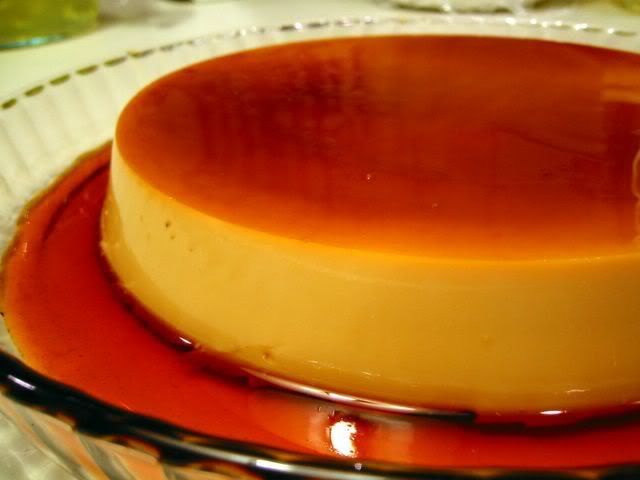
In my halo halo chronicle, I mentioned that I would make leche flan fairly soon. I didn’t anticipate it being quite so soon, two days later, but the opportunity presented itself with my day off and failure to write anything other than this blog entry. I’d had leche flan in halo halos and at Sugarland Hotel in Bacolod. It was delicious, naturally gluten-free, and pretty addictive. And, I saw, not too difficult to make, so why not?
After dinner came the moment I would try out my leche flan recipe. I found several recipes, here, here, and here, but all made unreasonably huge portions in the tradition of Filipino fiesta-sized eating habits. I saw from these, however, that I could steam cook leche flan, and I had just discovered that my rice cooker came with a steaming apparatus to add on. Lacking an oven and not really trusting a “water bath,” that I could steam my way into leche flan was very important. I decided on this recipe, due to its simplicity and portion size, but I had no llanera (Filipino leche flan mould), and even if I did, it wouldn’t fit into the modest rice cooker add-on. So, I made some modifications to this last recipe to accommodate my available materials, including steaming rather than bathing it in water. I bought aluminum muffin tins, which I cut into individual cups so they could be arranged to fit into my steamer. The recipe used makes a good amount of carmelized sugar to line the bottom of each tin. However, as for the custard, it made a little too much, but not outrageously so. Also, I used a 300ml can of condensed milk, largely because it was what is available and because the recipe doesn’t specify, even implying that any size is appropriate. In the future, I believe I will use less so as to minimize waste and because the mixture was quite runny, though I don’t know its proper consistency, and it far surpassed its 30 minute steam time, possibly due to its consistency, possibly due to my steamer.
So, here’s the recipe:
Carmelized Sugar:
1/3 cup brown sugar
1/6 cup water
Dash of salt
On a low heat (my low heat is still pretty high), dissolve the sugar and salt in water. The recipe says not to stir, but it wasn’t dissolving, so I swirled the pan a bit to dissolve it. Pour it into your mould or moulds; it should cover the bottom.
Custard:
4 egg yolks
1 can of condensed milk (I used 300ml)
1/3 water or milk measured by empty can of condensed milk (I used water)
Break and gently mix egg yolks to avoid bubbly custard. Empty the can of condensed milk into yolks, then put water or milk measured by the same can into the liquid. Mix gently. I went ahead and forgot the vanilla because apparently so did the recipe writer, but still came out with a delicious product. Here I noted that the mixture separates slightly; the condensed milk goes to the bottom, the egg and water stay on top. It never quite converges, and the urge to mix or whip it vigorously is fairly intense. Patience, grasshopper.
Strain the mixture as you fill the tins/your mould. This direction seemed odd to me, and I wanted to skip it for expediency’s sake, but I remembered the flourless chocolate cake debacle of 2008 with Ken, where the recipe called for, but didn’t explain, like this one, a technical aspect of the baking process. The results were dire that time, so, holding with faith, I strained the mixture into the tins, using a spoon to pour rather than dumping from my giant bowl into tiny tins. Turns out, the straining is done so that unintegratable egg bits are strained out rather than left to cook in. Another recipe says not to bother to strain, but I feel good about it. So, always follow directions, and if you’re writing recipes, always explain the rather opaque reasonings behind the processes so fools like me don’t skip it.
Cover tins with tin foil so the flan doesn’t get soaked in the steaming process. The recipe says to steam for 30 minutes, but only around the hour mark was it finally thickening up. I don’t know if that was the runniness of the custard mixture or a failure of my steamer to heat up quickly. Anyway, the time it took in comparison to the time it was supposed to take was a tad ridiculous. My final steam time: 1 hour, 30 minutes. Even after all that time, it never firmed up, and the results were unattractive in the extreme. Zeus. I refrigerated my tins overnight, and only then did they stay together when inverted onto a plate.
In case you try this in an oven and get positive results, I'll continue. In my opinion, it should be refrigerated for a long time, though the recipe does not call for this. Then, to remove your leche flan, gently run a knife along the edge of your mould and invert it onto a plate. Here is where many leche flans get destroyed. Mostly I don’t care what it looks like, but maybe next time it’ll be marginally more attractive. This recipe made six small muffin tins worth, with some custard mix left over. So, this is my truly hideous and out of focus individual portion of leche flan.

On the whole, I’m satisfied with the ease of preparation, flavor and portion size of this recipe, but not the cooking time or appearance/consistency of the final product. Next time, I will try not to forget the vanilla. Ultimately, the cook time and final product are cause to pause, but since I’m aware of this for next time, I won’t be dashing off every fifteen minutes to see if it’s ready yet, and I'll modify it to be less runny by adjusting the amount of condensed milk and water/milk added. In the future, I may also forgo the carmelized sugar. While delicious, it's a tad cloying and the custard needs no help to be sweet. I’ll also try to find something to do with the four leftover egg whites. In a past life, maybe I would think nothing of pouring them down the drain in the absence of something to do with them, but here that is more difficult.
Please note that I’ve added to the side of my blog a list of links to recipes I’ve been using, including this one, and recipes I intend to use when the opportunities arise. Some are Filipino recipes, others are not, but do check them out and enjoy. The recipes listed were chosen among the many available for ease of preparation, fewest or most reasonable/logical ingredients (one of the leche flan recipes called for the most expensive [eyeroll] organic eggs, carabao milk and something I’ve never heard of – no thanks), and clarity of direction. As I experiment with these recipes, I will post with results and modifications.
Next: Champorado
In my halo halo chronicle, I mentioned that I would make leche flan fairly soon. I didn’t anticipate it being quite so soon, two days later, but the opportunity presented itself with my day off and failure to write anything other than this blog entry. I’d had leche flan in halo halos and at Sugarland Hotel in Bacolod. It was delicious, naturally gluten-free, and pretty addictive. And, I saw, not too difficult to make, so why not?
After dinner came the moment I would try out my leche flan recipe. I found several recipes, here, here, and here, but all made unreasonably huge portions in the tradition of Filipino fiesta-sized eating habits. I saw from these, however, that I could steam cook leche flan, and I had just discovered that my rice cooker came with a steaming apparatus to add on. Lacking an oven and not really trusting a “water bath,” that I could steam my way into leche flan was very important. I decided on this recipe, due to its simplicity and portion size, but I had no llanera (Filipino leche flan mould), and even if I did, it wouldn’t fit into the modest rice cooker add-on. So, I made some modifications to this last recipe to accommodate my available materials, including steaming rather than bathing it in water. I bought aluminum muffin tins, which I cut into individual cups so they could be arranged to fit into my steamer. The recipe used makes a good amount of carmelized sugar to line the bottom of each tin. However, as for the custard, it made a little too much, but not outrageously so. Also, I used a 300ml can of condensed milk, largely because it was what is available and because the recipe doesn’t specify, even implying that any size is appropriate. In the future, I believe I will use less so as to minimize waste and because the mixture was quite runny, though I don’t know its proper consistency, and it far surpassed its 30 minute steam time, possibly due to its consistency, possibly due to my steamer.
So, here’s the recipe:
Carmelized Sugar:
1/3 cup brown sugar
1/6 cup water
Dash of salt
On a low heat (my low heat is still pretty high), dissolve the sugar and salt in water. The recipe says not to stir, but it wasn’t dissolving, so I swirled the pan a bit to dissolve it. Pour it into your mould or moulds; it should cover the bottom.
Custard:
4 egg yolks
1 can of condensed milk (I used 300ml)
1/3 water or milk measured by empty can of condensed milk (I used water)
Break and gently mix egg yolks to avoid bubbly custard. Empty the can of condensed milk into yolks, then put water or milk measured by the same can into the liquid. Mix gently. I went ahead and forgot the vanilla because apparently so did the recipe writer, but still came out with a delicious product. Here I noted that the mixture separates slightly; the condensed milk goes to the bottom, the egg and water stay on top. It never quite converges, and the urge to mix or whip it vigorously is fairly intense. Patience, grasshopper.
Strain the mixture as you fill the tins/your mould. This direction seemed odd to me, and I wanted to skip it for expediency’s sake, but I remembered the flourless chocolate cake debacle of 2008 with Ken, where the recipe called for, but didn’t explain, like this one, a technical aspect of the baking process. The results were dire that time, so, holding with faith, I strained the mixture into the tins, using a spoon to pour rather than dumping from my giant bowl into tiny tins. Turns out, the straining is done so that unintegratable egg bits are strained out rather than left to cook in. Another recipe says not to bother to strain, but I feel good about it. So, always follow directions, and if you’re writing recipes, always explain the rather opaque reasonings behind the processes so fools like me don’t skip it.
Cover tins with tin foil so the flan doesn’t get soaked in the steaming process. The recipe says to steam for 30 minutes, but only around the hour mark was it finally thickening up. I don’t know if that was the runniness of the custard mixture or a failure of my steamer to heat up quickly. Anyway, the time it took in comparison to the time it was supposed to take was a tad ridiculous. My final steam time: 1 hour, 30 minutes. Even after all that time, it never firmed up, and the results were unattractive in the extreme. Zeus. I refrigerated my tins overnight, and only then did they stay together when inverted onto a plate.
In case you try this in an oven and get positive results, I'll continue. In my opinion, it should be refrigerated for a long time, though the recipe does not call for this. Then, to remove your leche flan, gently run a knife along the edge of your mould and invert it onto a plate. Here is where many leche flans get destroyed. Mostly I don’t care what it looks like, but maybe next time it’ll be marginally more attractive. This recipe made six small muffin tins worth, with some custard mix left over. So, this is my truly hideous and out of focus individual portion of leche flan.

On the whole, I’m satisfied with the ease of preparation, flavor and portion size of this recipe, but not the cooking time or appearance/consistency of the final product. Next time, I will try not to forget the vanilla. Ultimately, the cook time and final product are cause to pause, but since I’m aware of this for next time, I won’t be dashing off every fifteen minutes to see if it’s ready yet, and I'll modify it to be less runny by adjusting the amount of condensed milk and water/milk added. In the future, I may also forgo the carmelized sugar. While delicious, it's a tad cloying and the custard needs no help to be sweet. I’ll also try to find something to do with the four leftover egg whites. In a past life, maybe I would think nothing of pouring them down the drain in the absence of something to do with them, but here that is more difficult.
Please note that I’ve added to the side of my blog a list of links to recipes I’ve been using, including this one, and recipes I intend to use when the opportunities arise. Some are Filipino recipes, others are not, but do check them out and enjoy. The recipes listed were chosen among the many available for ease of preparation, fewest or most reasonable/logical ingredients (one of the leche flan recipes called for the most expensive [eyeroll] organic eggs, carabao milk and something I’ve never heard of – no thanks), and clarity of direction. As I experiment with these recipes, I will post with results and modifications.
Next: Champorado
Saturday, February 21, 2009
Adventures in Pinoy Cuisine
Halo halo: my favorite Filipino food item. Most of my comrades have already posted their obligatory halo halo-themed entries, but I have been waiting for today. From the first time I had a halo halo, at the deeply buried hole-in-the-wall Tablespoon fairly late in training, I knew I was destined to make one - the best one, the ultimate halo-halo; I was going to be the one who made it. The perfection of the halo halo would be my secondary project. This single truth occupied my mind, biding its time through training, through my second homestay, through until today when I had the desired ingredients, the time and the space.
First, let’s look at the anatomy of a halo halo: on a bed of shaved ice, halo halogists across the nation pile any combination of the following ingredients and many, many more: pandan, big tapioca balls, gelatin, corn, garbanzo beans, mungo beans, some other kind of big white bean, pieces of leche flan, coconut strips, jackfruit, banana, mango, ube either in cube or jam form, ube or mango ice cream, cornflakes or puffed rice, condensed milk and sugar. Essentially, whatever’s lying around and convenient goes into the halo halo. While many of these ingredients may seem antithetical to dessert (beans?), I assure you, even the pickiest of palates is pleased by the product. Nonetheless, I have my favorite ingredients, and since moving into my own apartment, I have slowly been amassing these items for my future in halo halo production. Today, as I considered my languishing jar of ube jam, my soaked but purposeless tapioca balls and my fresh batch of strawberry Jell-o, courtesy of Marlene, I knew with certainty that my day had come.
I looked up the recipe for leche flan, and, upon discovering that my rice cooker is also a steamer, I desperately wanted to include it. However, I would have had to go out and find a mould or moulds small enough to fit inside the steaming add-on, so some other day will be the reckoning of the leche flan.
First, and perhaps most stupidly, I decided to crush my ice in the blender I had bought for that express purpose. Any halo halo enthusiast will tell you that the consistency of the ice is key; an ice miscalculation can destroy the entire experience. Well, my blender certainly does not crush ice. What I got was water and some humbled cubes, so I put it in a bowl and put it back in the freezer to see if more time would improve it in its current state. Then I set to work on the other ingredients.
I boiled my tapioca balls, small ones, and that was a success except I have no strainer. So I had hundreds of caviar looking tapioca balls in a puddle of their own juices, drained to the best of my ability with my finger against the lip of a tipping bowl.
I opened a can of condensed milk with my can opener. Or, if we’re being honest, I half opened it before the can opener’s parts sprung apart like teenaged lovers caught by Dad. That was fine, since it was condensed milk and would come out even in its half opened state. But. But, I had a can of whole kernal corn to open. And I had to do it Pinoy style: with a knife and my own brawn. So I gathered my nerve and went at the top of the can with a large, sharp chopping knife for about ten minutes before getting a large enough opening to fit a spoon in. I thought I would die or lose some fingers, but I am in tact and proud of it. Note to self: get a quality can-opener held together by more than the will of its maker.
Then I had three jars to open – ube jam, mungo beans and coconut strips. Twenty minutes later, I had none open and was trying desperately not to succumb to the urge to find a kindly Mormon man to open them. When I gave in and peaked outside, I saw only a man mixing concrete to continue the construction of my building and decided I was on my own. Eventually, I got the (essential) ube jam and the coconut strips open, but not the mungo beans, and considered it a success.
I cut a mango, cut some Jell-o into cubes, and brought out my bowl of water ice to begin the creation: sugar, Jell-o cubes, mango cubes, condensed milk, tapioca caviar, coconut, ube jam, ube ice cream, corn, and I was ready.
With great anticpation and exuberance I tucked in, only to find that my base ingredient, that most essential of items, my ice, was a travesty, an insult to halo halos everywhere. I ate it nonetheless, as the water turned a light opaque ube purple and the remaining ice cubes floated on top like little rounded mocking eyes. It was my first try, and marginally successful despite myriad pitfalls, and I now know that a blender will not suffice in the absence of an ice shaver. Until next time, ultimate halo halo.

First, let’s look at the anatomy of a halo halo: on a bed of shaved ice, halo halogists across the nation pile any combination of the following ingredients and many, many more: pandan, big tapioca balls, gelatin, corn, garbanzo beans, mungo beans, some other kind of big white bean, pieces of leche flan, coconut strips, jackfruit, banana, mango, ube either in cube or jam form, ube or mango ice cream, cornflakes or puffed rice, condensed milk and sugar. Essentially, whatever’s lying around and convenient goes into the halo halo. While many of these ingredients may seem antithetical to dessert (beans?), I assure you, even the pickiest of palates is pleased by the product. Nonetheless, I have my favorite ingredients, and since moving into my own apartment, I have slowly been amassing these items for my future in halo halo production. Today, as I considered my languishing jar of ube jam, my soaked but purposeless tapioca balls and my fresh batch of strawberry Jell-o, courtesy of Marlene, I knew with certainty that my day had come.
I looked up the recipe for leche flan, and, upon discovering that my rice cooker is also a steamer, I desperately wanted to include it. However, I would have had to go out and find a mould or moulds small enough to fit inside the steaming add-on, so some other day will be the reckoning of the leche flan.
First, and perhaps most stupidly, I decided to crush my ice in the blender I had bought for that express purpose. Any halo halo enthusiast will tell you that the consistency of the ice is key; an ice miscalculation can destroy the entire experience. Well, my blender certainly does not crush ice. What I got was water and some humbled cubes, so I put it in a bowl and put it back in the freezer to see if more time would improve it in its current state. Then I set to work on the other ingredients.
I boiled my tapioca balls, small ones, and that was a success except I have no strainer. So I had hundreds of caviar looking tapioca balls in a puddle of their own juices, drained to the best of my ability with my finger against the lip of a tipping bowl.
I opened a can of condensed milk with my can opener. Or, if we’re being honest, I half opened it before the can opener’s parts sprung apart like teenaged lovers caught by Dad. That was fine, since it was condensed milk and would come out even in its half opened state. But. But, I had a can of whole kernal corn to open. And I had to do it Pinoy style: with a knife and my own brawn. So I gathered my nerve and went at the top of the can with a large, sharp chopping knife for about ten minutes before getting a large enough opening to fit a spoon in. I thought I would die or lose some fingers, but I am in tact and proud of it. Note to self: get a quality can-opener held together by more than the will of its maker.
Then I had three jars to open – ube jam, mungo beans and coconut strips. Twenty minutes later, I had none open and was trying desperately not to succumb to the urge to find a kindly Mormon man to open them. When I gave in and peaked outside, I saw only a man mixing concrete to continue the construction of my building and decided I was on my own. Eventually, I got the (essential) ube jam and the coconut strips open, but not the mungo beans, and considered it a success.
I cut a mango, cut some Jell-o into cubes, and brought out my bowl of water ice to begin the creation: sugar, Jell-o cubes, mango cubes, condensed milk, tapioca caviar, coconut, ube jam, ube ice cream, corn, and I was ready.
With great anticpation and exuberance I tucked in, only to find that my base ingredient, that most essential of items, my ice, was a travesty, an insult to halo halos everywhere. I ate it nonetheless, as the water turned a light opaque ube purple and the remaining ice cubes floated on top like little rounded mocking eyes. It was my first try, and marginally successful despite myriad pitfalls, and I now know that a blender will not suffice in the absence of an ice shaver. Until next time, ultimate halo halo.

Subscribe to:
Posts (Atom)