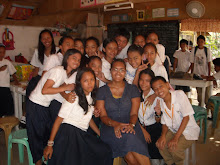
I mentioned briefly in my last post that I'm a participant in Coverdell World Wise Schools. Through this program, I'm matched with a classroom in the States and we can correspond as we wish, sharing pictures and stories. Hopefully, this results in students at home learning about a new culture along with their volunteers.
When I got a packet of letters from students in my World Wise Schools match, I was really impressed to see how much thought they had put into the questions they asked me and what they wanted to know about the Philippines and Philippine culture. Their questions were more intelligent and thoughtful than some of the questions I field from adults more than twice their age and experience.
I spent the afternoon answering the questions which recurred most often throughout the letters I received, and some questions I thought were really important. I couldn't answer them all, but I got to almost 20 of them and it occurred to me that some of the questions and answers deserved to be posted here. So, here are some questions from middle school students in New Jersey, and my humble answers to them. Warning: this is gonna be a long one, folks.
How can ordinary teenagers make a difference in the world?
Making a difference starts in your own community. The world is big and there are problems at your doorstep as well as half a world away. I wish I had done more volunteering closer to home, since I believe that volunteering in a soup kitchen or homeless shelter makes a greater direct, immediate impact on those in need at home than Peace Corps does abroad. There are many volunteer opportunities available if you just look: Habitat for Humanity, SPCA, 4H, various other community volunteer organizations designed for young people like the YES program, and, when you’re no longer teenagers, Americorps or Teach for America. You can also do adopt-a-highway programs, arrange a litter clean up, or try to start composting and organic farming or gardening. If there are causes you care about like fundraising for diabetes, cancer, HIV/AIDS or autism, there are opportunities for that as well. With time, energy and care, you can contribute to the wellbeing of your community in far greater ways than you can probably imagine.
Are you a better person for joining the Peace Corps?
Absolutely not! I am trying to become a more patient person, a more compassionate person, more understanding and more empathetic. Living in a different culture provides me opportunities to become better in those ways, but I have to work on it myself. However, I think the root of this question does not lie in what we are trying to develop within ourselves, but in buying into the essential nobility of joining the Peace Corps, which is a grave fallacy. We who join Peace Corps do have altruistic reasons for joining, but our reasons are not all selfless either. Of course there will be the people who say “I just want to help people!” Frankly, they're lying. As you can see from my answer about making a difference, you don’t have to go far to help people. Some volunteers want professional experience, some want to travel no matter where, some want high adventure, some want a totally different experience than most of their peers. My foremost reason for joining the Peace Corps was to be involved in something positive for the world, to put good karma into the ether in any way that I could help. I wanted to do HIV/AIDS education work, which I haven’t had a chance to do yet, and I wanted to provide individual attention to students who may struggle in English class. But I also wanted the teaching experience, I wanted to learn about a new culture, I wanted to experience completely new things, I wanted to travel, and I’m not ashamed of that. No Peace Corps Volunteer is any better a person than the volunteers and community organizers who devote their time to making the world a better place from home.
Did you want to be placed in the Philippines?
The Peace Corps has an extremely long, tedious and difficult application process which is too boring to explain. To put it simply: you don’t get to request where you will go. You may put in geographical preferences, like Eastern Europe or Latin America, and you can put where you don’t want to go, but because of your skills set, which determines what job sector you’re qualified for, and your medical needs, which determines which countries you can or cannot be sent to, you are never guaranteed anything as far as your geographical preference. They may even put you exactly where you didn’t want to go, but this shouldn’t be a deterrent. My father served in the Peace Corps during the Vietnam war, and he wanted to go to French-speaking Africa, and he didn’t want to go anywhere near the war. Well, they sent him to Thailand, right next to Vietnam, and he had the time of his life.
Personally, I wanted to go to Thailand because it’s part of my heritage and I speak Thai. Turns out, this is exactly why I was barred from ever going to Thailand with the Peace Corps. They want their volunteers to experience a totally new culture. Once I knew this, I put as my preference, like my father before me, Francophone West Africa. The Peace Corps was recruiting for French speakers, they were excited about my desire to serve in Africa, which is where the fewest people want to go, and I was nominated for a program in Francophone West Africa. However, during my long medical screening process, I found out that I’m unable to eat gluten (a protein found in wheat, barley and rye), and I could not go to West Africa as a result. Peace Corps decided to send me to Southeast Asia, reminding me that it wouldn’t be Thailand, and in the end I was extremely happy to come to the Philippines.
What do you miss about America?
Of course I miss my friends and family. 27 months is a long time to be apart from them. I’m missing out on weddings, funerals, births, many crucial moments in the lives of my loved ones because I made the decision to be here. I knew that at the outset, of course, but faced with the reality of missing these moments, these people, it’s much harder to shrug off the time factor.
The other big thing I miss is food. Since I’m gluten intolerant, it’s not always easy for me to eat here, though of course not as difficult as it would be in other parts of the world. Filipinos have been very much influenced by 400 years of Spanish rule and 50 years of US occupation. That means that they use many Western ingredients that I can’t have, and because of the threat of contamination, it’s even harder for me. If something I am able to eat, like a fried fish, is touching a breaded piece of pork, or was fried in oil that previously fried something battered by flour, then I can’t eat it. I have been able to remain healthy here, but only through vigilance and discipline and culinary abstinence. So I miss the food I can get easily at home: gluten-free breads, cereals and desserts; peanut butter; Thai food; sushi; candy, chips and junk food.
Do you speak a foreign language? Do you speak Filipino?
Any foreign language? I grew up speaking both English and Thai in my house, and I spent about five years studying French in middle and high school.
There are hundreds of languages and dialects in the Philippines. English and Filipino, which is actually Tagalog, are listed as official languages. When my group of volunteers, Philippines batch 267, got here, we were split into three geographical and linguistic groups which would determine where our permanent sites would ultimately be. My group was sent to Dumaguete on Negros Oriental, part of the Visayas (Vi-SY-ahs). For three months, we spent intensive classtime learning Cebuano, or Visaya, or Bisaya. Cebuano has 20 million native speakers throughout the Visayan islands and greater Philippines, whereas Tagalog has 11 million.
Because the Philippines has such a high rate of moderate English proficiency, it is possible to get by without learning a Filipino language very well. Some volunteers never speak it at all. As a teacher, I am obligated to speak English all day at work, so learning is especially difficult for English Education volunteers because they aren’t as immersed in the language as volunteers in other sectors in the Philippines, coastal resource management (CRM) and children, youth and families (CYF).
What do you do in your spare time?
I read a lot of books. I have been here for almost eight months now, and I am currently reading my 23rd book since arriving in country. This is more than I’ve read for pleasure since I was in middle school myself. It’s very satisfying to have the time to read what you want, for whatever reason you want. I also use the internet a lot, and I try to spend time writing. Some weekends, I visit other volunteers relatively close to me.
Do the Philippines have seasons?
The Philippines have basically two seasons: ting-uwan (rainy season) and ting-init (hot season). It is both rainy and hot during both seasons, but the intensity of the rain during ting-uwan is shocking, as is the intensity of the heat during ting-init.
Over the course of the year, there are other mga ting (seasons), like ting-ani (harvest season), ting-prutas (fruit season), ting-bagyo (typhoon season), ting-mangga (mango season), and so on and so forth. Anyting goes. We have a joke among the Peace Corps volunteers: we’ll add the word ting before anything. It’s always ting-uncomfortable, we’ll say of the weather. It’s ting-ako na (season of me, now).
What kinds of sports and music are popular in the Philippines?
Basketball is a big, big past time here. If there isn’t a decent basketball court in every neighborhood, there’s at least a makeshift one. There are informal games all the time, and plenty of people from the neighborhood or community will come to watch. My host brother would turn the TV to a sports channel and watch basketball, past games and present, all day, and then watch shows about basketball players. Philippines national obsession. With the emergence of Manny Pacquiao, Filipino boxing legend and recent defeater of Oscar De La Hoya, boxing has gained popularity.
Filipinos love all kinds of music, without irony. Celine Dion, Queen, Mariah Carey, the Star Wars theme, Christmas music no matter the ting, the Carpenters, stadium evangelical gospel, anything. Videoke (karaoke with moving pictures of anything you can think of on the screen) is another national obsession, and you can hear it all the time. My students particularly enjoy current American hip-hop, and it can be heard at all times, and they frequently prepare dance numbers to it.
What is Filipino food like? Do you like it?
Filipinos eat white rice at every meal, even breakfast. For some volunteers, this is a big adjustment and sometimes one which they will never get used to or come to enjoy. Personally, because I am used to eating rice regularly and because I can’t eat common items like bread or flour, I really prefer to eat rice anyway, so it’s not a problem for me. Filipino main dishes are usually fried or boiled, they often contain a lot of fish and pork, and their main seasonings are salt and soy sauce. Because soy sauce contains gluten, sometimes my host families had trouble finding things to make for me. However, with a little imagination, they were able to remove the soy sauce or substitute it with something safe for me. I like many Filipino foods, but because of my dietary restrictions I am often limited in what I can have and how it can be flavored, resulting in the same kinds of bland dishes over and over. Now that I live on my own, I can make my own food, and generally I wouldn’t describe it as Filipino. I am, however, very much into eating and making Filipino desserts.
Showing posts with label the application process. Show all posts
Showing posts with label the application process. Show all posts
Wednesday, March 25, 2009

Saturday, November 1, 2008
Goodbye Dumaguete, I've got to go
One year ago today I was nominated for a June departure to Francophone Sub-Saharan Africa. I have come through so much to be where I am today: a week away from swearing as a Peace Corps volunteer with the 267th batch of volunteers in the Philippines. I feel like my personal strides have mirrored my Peace Corps progress somehow. I was diagnosed with this autoimmune disease just as I was sending in my medical kit in December, and as I struggled to navigate and control my emotions around such a difficult diagnosis, a lifelong ailment that I could only control through strict dietary discipline, I struggled too to prove I was medically fit to join Peace Corps, that my mind was strong enough to overcome the failures of my broken body and strive regardless of my physical shortcomings. I had to prove to myself and to the Peace Corps that I could take care of my own health without faltering, and I finally grew more comfortable and less angry with my fate as a gluten intolerant just as I achieved medical clearance. Medical clearance came at about the same time I was awarded the Portia Dunham award in fiction from my university. I had to mount a crusade against a Peace Corps placement which would have insured my failure just as I was coming into the final assignments of my senior year, and I was placed to my immune system’s satisfaction, here in the Philippines, about the same time that I graduated. I was coming out the victor in everything I had striven so hard for: Peace Corps, my health, my fiction, my degree. And while I’ve been training here, I have been able to overcome despair, bitterness and frustration from many sides, such that I barely remember the sensation of having to force myself through to the next moment without losing control of my motivation, my emotions, my body, my hopes. Some days I can’t fathom how long the next two years in Leyte will be, but today is a big day for me. It’s a year of having been in the application process and training and coming out triumphant at every turn. It’s a year of personal gain and growth and healing. It’s a year where I’ve felt intense motivation for the work I’ve chosen in fiction. I breathe: mind over matter.
In non-overarching metaphor news, I achieved a score of intermediate-mid on my Language Proficiency Interview. There are three sections, novice, intermediate, advanced, and within each there are three tiers, low, mid, high. Beyond that there is superior, which they really don’t award people, and then native speaker. A few people in Dumaguete achieved intermediate-high and two people achieved advanced-low. I’m very pleased with my score, with the scores of all of those in my cluster, and we’ve made our teacher proud, which I consider possibly the most important thing. Maybe I’ll never get much better than that because of the nature of my job and the Philippines, but this is tangible evidence of something I worked for during training. This is the fruit of the four hours per day I spent in class and the countless hours of homework and study I did outside of class.
So this is it for those of us who came to Dumaguete and weren’t assigned here. Early tomorrow morning we’ll leave for a conference in Bacolod, swear in as volunteers on the 7th, and head into this two year experience we’ve been waiting so impatiently for. Here now, a pictoral ode to my cluster, training and Dumaguete.
 alt=""id="BLOGGER_PHOTO_ID_5263460308988529330" />
Lechon. It's just not a party without one.
 alt=""id="BLOGGER_PHOTO_ID_5263458260094075874" />
The awesome Bantayan cluster. That's Sean, May, our teacher, Syd, me, Spiderman (or Denzel, Jessica's host nephew, who can't resist a picture), Dan and Sheryll. Bringing up the attractiveness statistics of Peace Corps volunteers everywhere.
 alt=""id="BLOGGER_PHOTO_ID_5263457260209222466" />
Lynn of the Casa Miani group, presenting something I only wish I could eat, yesterday at the handog.
 alt=""id="BLOGGER_PHOTO_ID_5263456097757181986" />
The cathedral. Built in 1754, the oldest and tallest Spanish church on Negros

old-timey firetruck

Happy Fred's on the Boulevard. I never went because it's always full of tambok og puting nga mga lalaki, but the name made me think of my grandpa. Hi Grandpa!
In non-overarching metaphor news, I achieved a score of intermediate-mid on my Language Proficiency Interview. There are three sections, novice, intermediate, advanced, and within each there are three tiers, low, mid, high. Beyond that there is superior, which they really don’t award people, and then native speaker. A few people in Dumaguete achieved intermediate-high and two people achieved advanced-low. I’m very pleased with my score, with the scores of all of those in my cluster, and we’ve made our teacher proud, which I consider possibly the most important thing. Maybe I’ll never get much better than that because of the nature of my job and the Philippines, but this is tangible evidence of something I worked for during training. This is the fruit of the four hours per day I spent in class and the countless hours of homework and study I did outside of class.
So this is it for those of us who came to Dumaguete and weren’t assigned here. Early tomorrow morning we’ll leave for a conference in Bacolod, swear in as volunteers on the 7th, and head into this two year experience we’ve been waiting so impatiently for. Here now, a pictoral ode to my cluster, training and Dumaguete.
 alt=""id="BLOGGER_PHOTO_ID_5263460308988529330" />
 alt=""id="BLOGGER_PHOTO_ID_5263458260094075874" />
 alt=""id="BLOGGER_PHOTO_ID_5263457260209222466" />
 alt=""id="BLOGGER_PHOTO_ID_5263456097757181986" />

Friday, June 6, 2008
The Obligatory Introduction
It's been a long road frought with peril and bureaucracy, but I'm finally here. On May 29th, I received my invitation to join the 267th group of Peace Corps volunteers in the Philippines, leaving on August 13th. I am both anxious and excited, and I know that this will impact my life in ways I can't yet anticipate. I am very much looking forward to meeting my fellow 267ers, my students, my co-workers, the people of the community in which I'm placed and anyone else who might cross my path. My life is gaining momentum.
Here is an overview of my journey to the Peace Corps:
My father is an RPCV who served two tours in Thailand in the early to mid 1970s. For my entire life, I have known what the Peace Corps does and how drastically it changed almost everything about him for the positive. During college and especially during my own application process, I came to realize how much his time in Thailand, which lasted much longer than his service, has meant to him. I began to consider joining during my junior year in college, which I spent in Scotland being ecstatic and frolicking over every available surface.
My father always said, "I wanted to see the world, and I didn't want to pay for it." The benefits of the Peace Corps, which are certainly not limited to the professional and financial, were too wonderful for me to pass up. In the Peace Corps, I could see parts of the world I'd never imagined, become a better version of myself, experience a completely different life, develop valuable skills, meet incredible people and maybe even contribute to society if I'm very lucky. So, in mid-October 2007, I began the application process.
On Halloween, I had an interview with my recruiter, who would become my strongest supporter and for whom I have a lot of appreciation and admiration. On November 1st, she nominated me for my first choice location, Francophone Sub-Saharan Africa, leaving June 2008. I was very happy. I got my medical kit in during the third week of December, mere days before I would be diagnosed with gluten intolerance by a gastroenterologist. Though devastating, this diagnosis would explain debilitating symptoms which had disrupted my life since the summer I was fifteen. Unluckily for me, my medical kit did not read "gluten intolerance" but "IBS." On December 27th, I was told I could not join the Peace Corps with "IBS," but since I suddenly had a name for my actual medical issue, I was determined to go forward. I wrote an appealing letter, including my new medical evidence, and received a call from my screening nurse, who said she would reopen consideration of my case once the efficacy of my new diet was reevaluated in March.
At the end of March, I was officially diagnosed with gluten intolerance and my doctor sent my screening nurse the latest medical evaluations and a letter stating his confidence in my ability to serve in the Peace Corps. I got another call from my screening nurse saying I was cleared on gluten intolerance, but now she had to go over the rest of my medical kit, which had apparently not been cracked since December. I was relieved and happy, and during April, I sent in a few more labs and statements for final medical clearance.
On May 2nd, I received the much-coveted medical clearance. I really cannot now articulate the level of my happiness, as I thought this was the end of my travails. There was a two page list of countries that could support my diet, and I was driving hard into the busy end of my senior year. About a week before graduation, I received another call, this time one that would raze my spirits and make me very, very nervous.
I realized that it was just slightly too late for my original nomination date, but that suited me just fine as I now wanted to go to the Wesleyan Writers Conference, which would have been later than my leaving date. The call I got, however, said that I could not go to Francophone Africa at all. For six months, I had anticipated time in that region and was rather unhappy about not being able to go. Then, my placement officer said she wanted to send me to the Central Asian Caucasus region. I knew nothing about these countries except that they were practically in Europe, and didn't that mean they ate exactly the food that I really, really cannot? I did some research and found out not only do they eat that food, but they sometimes revere it. Going to the Caucasus region would be tantamount to a death sentence. I would not have been able to eat much of anything, I would have had to be rude to my hosts by refusing meals, and, most likely, I would have had gluten reintroduced into my system and become ill again. I contacted my screening nurse, who assured me that any country on the gluten-free friendly list was safe, but nonetheless offered to check with country-specific medical to confirm.
A week later, the Friday before graduation weekend, I received another call from my screening nurse saying that the Caucasus region was indeed not the best place for me. She took it off the gluten-free friendly list of countries, and now no one with my affliction will ever have to go there and be ill. I was relieved, though now I had no nomination and no idea as to where the Peace Corps might send me.
A week and a half after that, I was still operating without news of a new nomination. I was hoping for Asia or non-Francophone Africa, but I was willing to go anywhere they wanted to send me and always had been. My father had not originally wanted to go to Thailand at all, but clearly he had a wonderful experience, and I was sure that wherever the Peace Corps decided to send me, I would be able to appreciate and enjoy that place as well. While visiting with my friend and her parents on Tuesday, May 27th, I received a call from placement asking me how I felt about Southeast Asia, teaching secondary school English, mid-August departure. Of course I was incredibly enthusiastic about both the location and the bountiful (and safe) rice that I was sure to encounter, and on Thursday, the 29th, I had that invitation to the Philippines in my hands. I probably didn't stop squealing for a solid five minutes. After looking over everything with loads of delight, I accepted my invitation the next morning.
So, I've sent in my passport and visa paperwork. I'm now working (procrastinating) on my tailored resume and aspiration statement. I've set up this blog so I can keep people back home updated during my service. I am so excited for what I have chosen to do with this time in my life after undergrad, when the opportunities seem boundless and I have no obligation but the one where I keep myself happy and stimulated. I know I've made the right decision, and I'm so happy to have been placed in the Philippines. I could not imagine a better placement, and I can't wait for the latest adventure to start.
Subscribe to:
Posts (Atom)